
Clearfield County Criminal Records
A Clearfield County criminal court record is the case-level record kept once charges are filed and the matter moves through court. It can begin in a Magisterial District Court for arraignment, bail, warrants, preliminary hearings, summary matters, traffic-related offenses, or lower-level cases. More serious criminal cases move to the Court of Common Pleas, which is the trial court of general jurisdiction for the 46th Judicial District. The record can include the charge list, docket entries, pleas, motions, hearing history, verdict or plea result, sentence, financial entries, and later filings.
The criminal case file should not be confused with an arrest record. An arrest record is tied to the arrest and booking side. A criminal court record is tied to the court case and its outcome. For charge-focused details, the Clearfield County arrest records and court charges page follows the arrest-to-charges path, while this criminal court records page stays focused on the case file and court result.
Find Clearfield Criminal Court Records
The main online route for Clearfield County criminal court records is UJS Case Search. UJS public docket sheets cover criminal courts of common pleas and magisterial district courts. The portal supports searches by docket number, participant name, complaint number, incident number, OTN, SID, attorney, date filed, calendar event, and other identifiers. The county filter can be set to Clearfield, and the judicial district can be set to the 46th Judicial District when the search path allows it.
- Open UJS Case Search and select the strongest available search type, such as participant name, docket number, complaint number, incident number, OTN, or SID.
- Filter to Clearfield County or Judicial District 46 to avoid matching cases from other Pennsylvania counties.
- Open the criminal docket and check the court office, case category, filing date, defendant name, and docket number.
- Read each charge, event, plea, disposition, bail entry, sentence entry, and cost or fine line separately.
- Contact the Clerk of Courts side of the Prothonotary and Clerk of Courts if a certified copy or full file review is needed.
UJS also promotes PAeDocket as a free mobile path for public case and docket searching. PAeDocket can search by case number, participant name, organization name, offense tracking number, police incident or complaint number, or state ID number. Secure docket sheets may include more content, but secure access is not the normal public search path.
Clearfield Criminal Case Flow
Criminal court records show movement through the case. A case can start with a complaint or citation, move through a preliminary arraignment, bail decision, preliminary hearing, formal common pleas filing, plea or trial, disposition, sentencing, and post-sentence or post-conviction activity. In Clearfield County, Magisterial District Judges preside over arraignments, set and accept bail, issue warrants, and hold preliminary hearings. The Court of Common Pleas handles the full criminal case when the matter proceeds beyond the lower-court stage.
Case flow: Charges Filed › Arraignment › Preliminary Hearing › Pretrial Motions › Plea or Trial › Disposition › Sentencing
| Stage | What Happens |
|---|---|
| Charges Filed | A complaint, citation, or formal charging document identifies the alleged offenses and starts the court path. |
| Arraignment and Bail | The court advises the defendant of charges and addresses release, bail, or detention conditions. |
| Preliminary Hearing | An MDJ screens whether the case has enough support to move forward on charged offenses. |
| Pretrial and Motions | Attorneys file requests, notices, continuances, suppression motions, or other court pleadings. |
| Plea or Trial | The case resolves through plea, trial verdict, dismissal, or other disposition. |
| Sentencing | The court enters penalties, supervision, costs, fines, confinement terms, or other ordered conditions. |
Clearfield Criminal Record Fields
UJS criminal and MDJ dockets can show charges, offense tracking number, complaint number, incident number, citation number, police agency, disposition, sentence, bail information, hearing events, costs, and fines when public. Civil CountySuite is not the main criminal case search route, although the county civil category list includes criminal summary appeals and criminal appeal to Superior Court as special categories. The criminal docket should be read field by field because one case may list several charges with different results.
| Field | What It Shows |
|---|---|
| Docket Number | The official case number used to identify the criminal matter in UJS or the clerk's office. |
| Defendant | The person charged in the court case, with public identifying details limited by access rules. |
| Charges | Each alleged offense, often with statute, grade, count, complaint, incident, or OTN details. |
| Plea | The defendant's formal answer, such as guilty, not guilty, or another court-accepted plea event. |
| Disposition | The result for the case or charge, such as guilty, not guilty, dismissed, withdrawn, or held for court. |
| Sentence | Confinement, probation, parole, fines, costs, supervision, or other conditions ordered after conviction. |
| Bail | Release conditions, bond activity, or bail status where public. |
| Events | Hearings, filings, continuances, orders, and post-conviction entries. |
Charges vs Convictions
A charge is an accusation filed in court. A conviction is a result after a guilty plea, guilty verdict, or other legally sufficient finding. Clearfield County criminal court records can list charges that were later amended, reduced, dismissed, withdrawn, or resolved in different ways. That is why each count must be read with its disposition and sentence line instead of treating the whole charge list as a conviction list.
| Point | Charge | Conviction |
|---|---|---|
| Meaning | An allegation filed by police or prosecutors. | A final finding or plea that results in guilt. |
| When it appears | Early in the case, often before final review. | After plea, verdict, or court finding. |
| How to verify | Read the count and status. | Read the disposition and sentence entries. |
| Common risk | Assuming every charge led to guilt. | Missing that only some counts resulted in conviction. |
Clearfield County Criminal Offices
Criminal court records are shaped by several offices. District Attorney Ryan P. Sayers is listed at the Courthouse Annex, 230 East Market Street, Clearfield, PA 16830, with phone 814-765-2641 ext. 5017 and fax 814-765-6792. The DA page says the office coordinates with four Pennsylvania State Police barracks and three municipal police departments and prosecutes over 1,200 criminal cases in Clearfield County each year. That local scale explains why a criminal search may show police incident numbers, complaint numbers, and multiple agencies.
The manifest image from the District Attorney source links to the county DA page used for Clearfield County criminal court records context.
The DA office is part of the charging and prosecution process, but public court access still runs through UJS and the court clerk channels.
The county also lists attorney profile information for prosecutors in the District Attorney's office.
Those profile pages support office identity and staffing, not a separate criminal docket search.
Public Criminal Court Access
Public access to Clearfield County criminal court records is governed by the UJS Case Records Public Access Policy and related Pennsylvania statutes. Public web docket sheets can be searched, viewed, and printed for criminal courts of common pleas and magisterial district courts. Secure docket sheets contain additional content not available for public viewing and require secure login. Public calendar schedules cover criminal common pleas and MDJ events, while secure calendars add more detail for authorized users.
Expungement and limited access affect visibility. 18 Pa.C.S. Section 9122 governs expungement of eligible criminal history information. 18 Pa.C.S. Section 9122.1 allows limited access petitions for qualifying records after statutory conditions are met. Juvenile expungement has a separate statute. The county Prothonotary page also says juvenile records, mental health records, sealed cases, and sealed documents are not accessible to the public.
Note: Public criminal dockets can omit sealed, juvenile, mental health, and confidential information even when the case number is visible.
Sealed vs Expunged Records
Sealing, limited access, and expungement are different remedies. A sealed record is closed by statute or court order and is not available to the general public. Limited access shields qualifying records from most non-criminal-justice dissemination after a petition is granted. Expungement removes eligible criminal history information under Pennsylvania law. A dismissed charge is not automatically gone from every public record, so the docket should be checked for an expungement, limited access order, or other court action.
| Point | Sealed | Expunged |
|---|---|---|
| Public visibility | Closed or hidden by law or court order. | Eligible record information is removed or treated under expungement rules. |
| Access path | Usually requires legal authority or a court order. | Requires statutory eligibility and court process. |
| Common examples | Juvenile, mental health, adoption, sealed filings, and protected documents. | Eligible criminal history under Pennsylvania expungement law. |
| What to verify | Whether the record is sealed, redacted, or confidential. | Whether an expungement order was granted and processed. |
Federal Criminal Records
Some criminal matters tied to Clearfield County are federal rather than county court cases. Clearfield County is in the U.S. District Court for the Western District of Pennsylvania, and the U.S. Attorney's Office for the Western District confirms Clearfield County is in the Johnstown region. Federal criminal case records are not searched in UJS or CountySuite. They use PACER and federal court systems.
The manifest image links to the U.S. Attorney's Office source used to place Clearfield County in the Western District's Johnstown region.
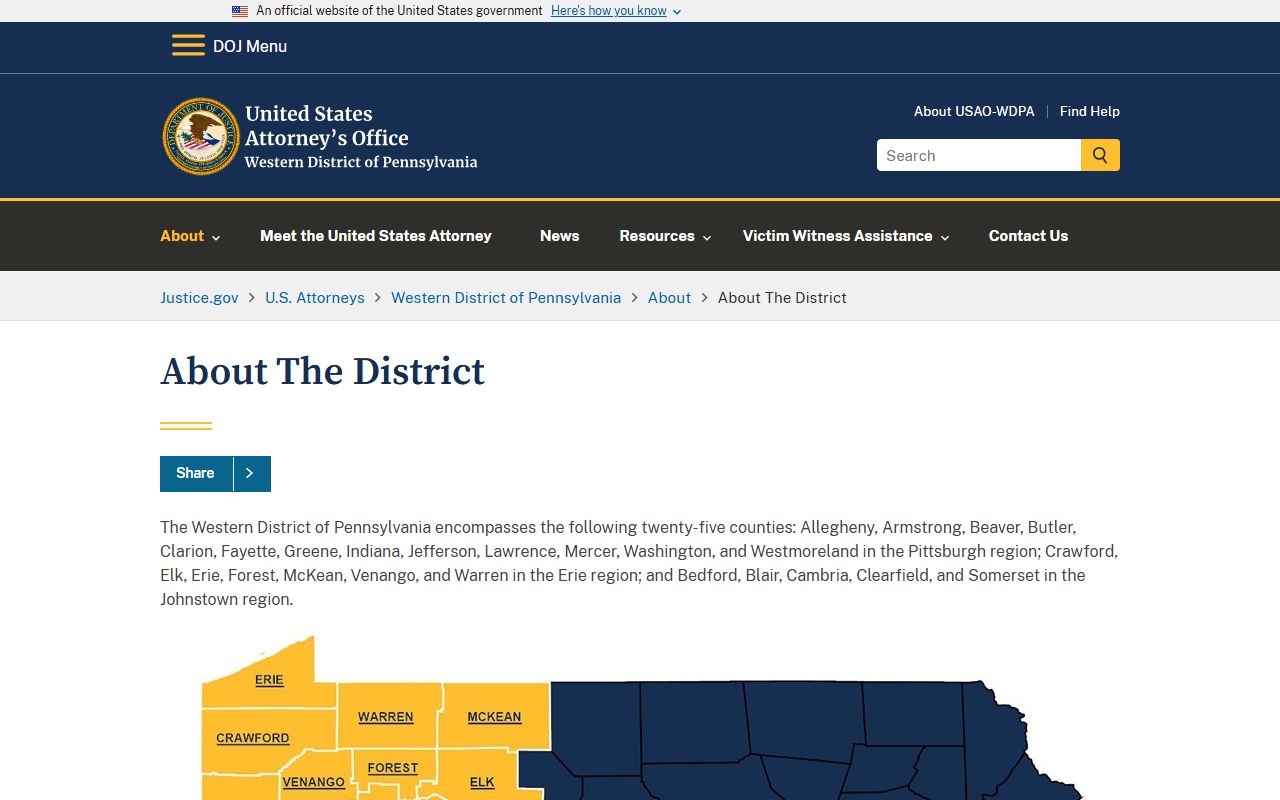
That federal source helps separate county criminal court records from federal prosecutions, bankruptcy, and federal appeals.
Criminal Record Copies
When a public UJS docket is not enough, the next channel is the custodian tied to the record. Common pleas criminal file questions go to the Clerk of Courts side of the Clearfield County Prothonotary and Clerk of Courts. The office is associated with Suite 124 at 1 North Second Street, Clearfield, PA 16830, and the staff directory lists phone 814-765-2641 ext. 5013 with alternate extension 5014. MDJ file questions should go to the specific lower court named on the docket.
The Public Defender office is a separate legal office for people who meet financial guidelines and need criminal defense representation. The research states that the office does not handle civil matters and that adult applications must include financial verification and, where available, the police criminal complaint and affidavit of probable cause. Those application rules are not a public record search path, but they show why complaint and affidavit documents may matter in criminal cases.